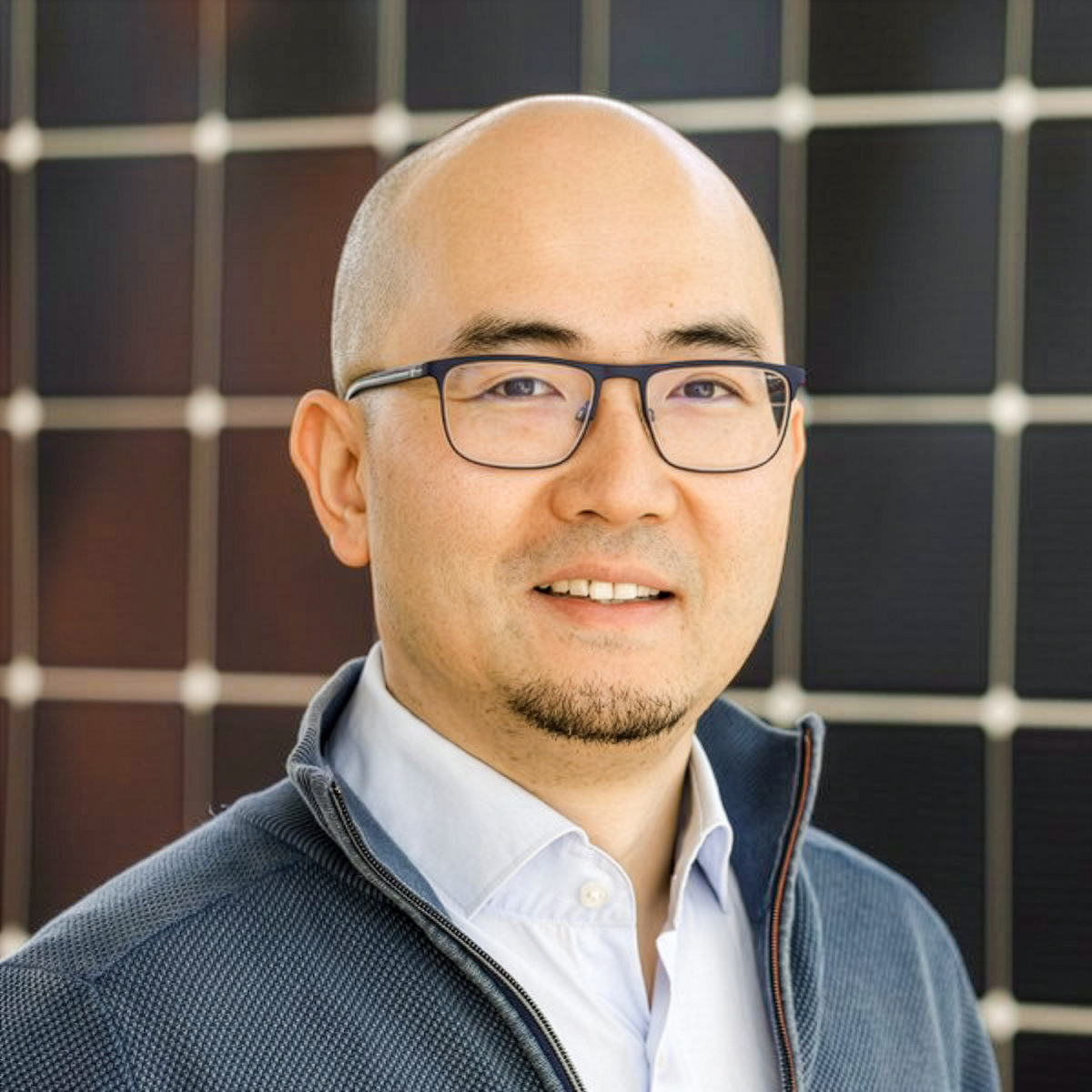
Click image for HiRes
Abstract
In the recent years, the silicon heterojunction solar cell development at Forschungszentrum Jülich has transitioned to perovskite silicon tandem solar cell research using silicon heterojunction as bottom cell. We spent many efforts on the optimization of the bottom cell as well as the establishment of the top cell technology resulting in a cell platform with average efficiency around 33% on small size devices. This talk with showcase few interesting development steps and findings discovered during this transition. From here, the research will focus on crystallization control, machine learning, automatic processing, industrial scaling, and stability assessment. A description of these ongoing activities will be given.
Click here to see all available video seminars.
Click here to go to the SPREE HOMEPAGE.
Brief Bio
Kaining Ding studied material science at the RWTH-Aachen University in Germany. He is with the Forschungszentrum Jülich in Germany since 2010 and currently leading
the PV-Thync Lab at IMD-3, Forschungszentrum Jülich. Research activities include silicon heterojunction and perovskite-silicon tandem solar cells and modules. He is the co-founder of the international silicon heterojunction workshop, the international integrated PV workshop and the international tandemPV workshop and a committee member of EUPVSEC, PVSEC, and SNEC.
